
The tremendous increase in allergy in the African continent cannot simply be explained by the change in public hygiene. There are many “prehygiene” communities with sewage-contaminated water supplies, helminth infestations, bare footedness, and poor housing, and still there is a high prevalence of allergic disease. Africans can be exposed to many risk factors facilitating severe asthma and wheezing, including airborne viruses, smoke, indoor dampness, cockroaches, and poor access to health care.
Ecological infrastructure (EI) refers to ecosystems that deliver services to society, functioning as a nature-based equivalent of, or complement to, built infrastructure. EI is critical for socio-economic development, supporting a suite of development imperatives at local, national and international scales. This paper presents the myriad of ways that EI supports sustainable development, using South Africa and the South African National Development Plan as a case study, linking to the Sustainable Development Goals on a global level.
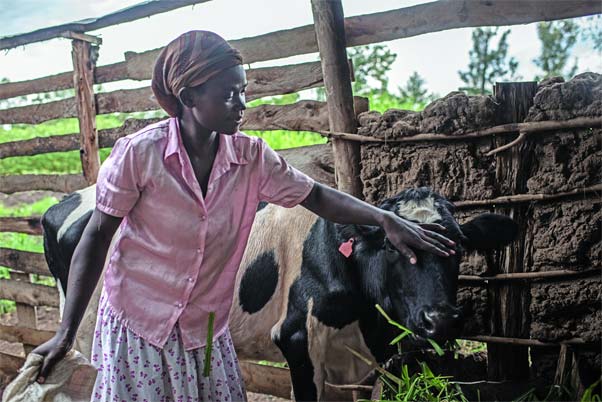
Nearly 30 years on from its launch by a group of UK West Country dairy farmers, the charity Send a Cow is making a big difference to people’s lives in seven countries in Africa. With its new campaign under way, Farmers Weekly finds out what the charity hopes to achieve and how farmers abroad are benefiting with the help of their UK counterparts. Endeavours such as this support SDG 1 No Poverty, and SDG 2 Zero Hunger and are a great example of SDG 17 Partnerships for the goals in action.
Background The Sustainable Development Goals strongly focus on equity. Goal 5 explicitly aims to empower all women and girls, reinforcing the need to have a reliable indicator to track progress. Our objective was to develop a novel women's empowerment indicator from widely available data sources, broadening opportunities for monitoring and research on women's empowerment. Methods We used Demographic and Health Survey data from 34 African countries, targeting currently partnered women.
‘Biosphere reserve’ is a United Nations (UN) designation stipulating that a region should attempt to follow the principles of sustainable development (SD). This paper adopts a stakeholder analysis framework to analyse the discourses of those tourism stakeholders who can actively affect SD in the Waterberg Biosphere Reserve (WBR), South Africa. Adopting an inductive qualitative methodology generated multiple research themes which were subsequently analysed using critical discourse analysis (CDA) techniques.
Existing studies on adaptation to climate change mainly focus on a comparison of male-headed and female-headed households. Aiming at a more nuanced gender analysis, this study examines how husbands and wives within the same household perceive climate risks and use group-based approaches as coping strategies. The data stem from a unique intra-household survey involving 156 couples in rural Kenya. The findings indicate that options for adapting to climate change closely interplay with husbands’ and wives’ roles and responsibilities, social norms, risk perceptions and access to resources.
Calibrated models can reasonably capture descriptions between input and output variables and can thus be used to estimate long term groundwater levels.
Climate change, population growth and rapidly increasing urbanisation severely threaten water quantity and quality in Sub-Saharan Africa. Treating wastewater is necessary to preserve the water bodies; reusing treated wastewater appears a viable option that could help to address future water challenges. In areas already suffering energy poverty, the main barrier to wastewater treatment is the high electricity demand of most facilities.
Fossil fuel subsidies are a key barrier for economic development and climate change mitigation. While the plunge in international fuel prices has increased the political will to introduce fossil fuel subsidy reforms, recently introduced reforms may risk backsliding when fuel prices rebound − particularly if they fail to address the underlying mechanisms that create demand for low fossil fuel prices. Extant literature has mostly focused on the consequences of fossil fuel subsidies, including their economic or environmental impact, and the social contract that make their reform difficult.
The Elsevier Foundation partners with the African Journal Partnership Program, pairing African health and medical journals with leading biomedical journals from the US and UK to build editorial skills through journal mentoring and training. Elsevier volunteers can spend up to one month supporting African journals to boost knowledge exchange, in line with SDG 10.
